

Directed Energy Weapons Market Size and Growth 2026 | USD 35.32 Billion by 2034
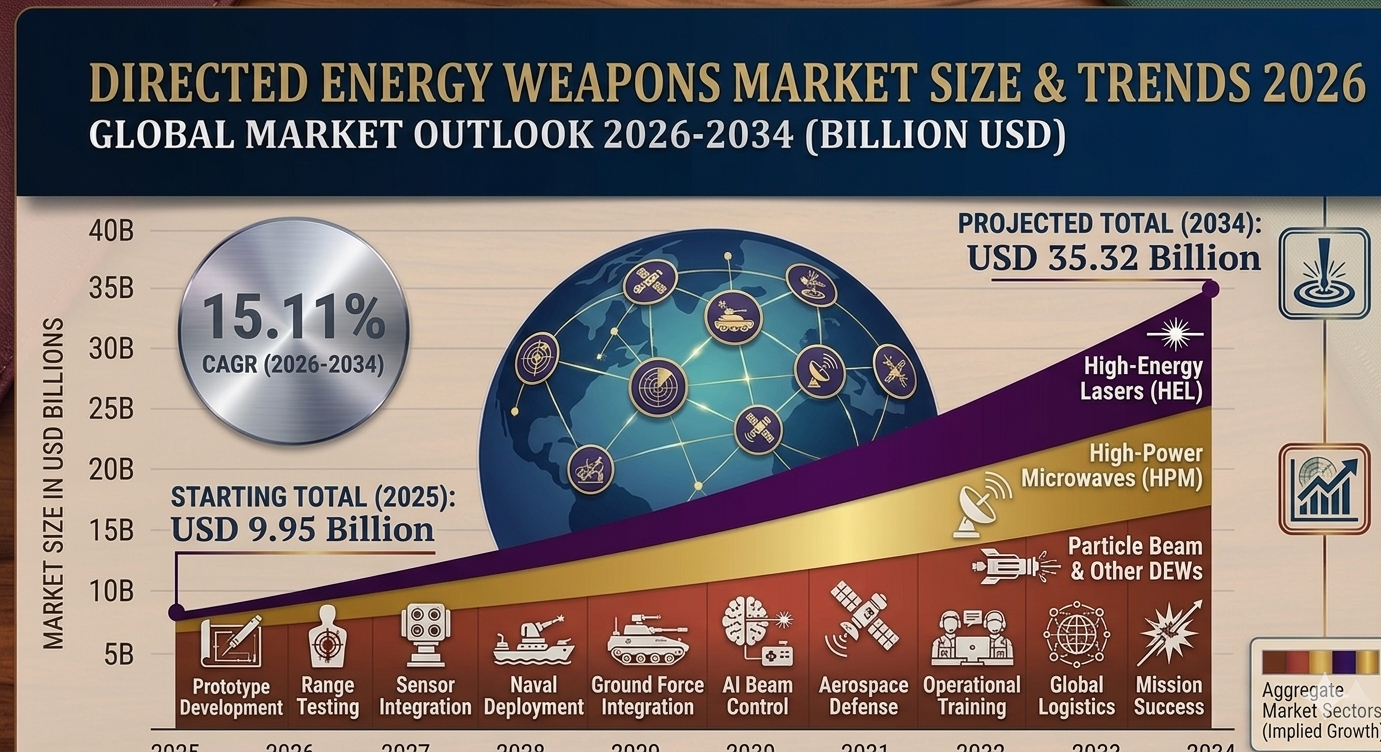
North America commands 36.7% of the global DEW market - approximately USD 3.67 Billion in 2026.
ST. BROOKLYN, NY, UNITED STATES, April 22, 2026 /EINPresswire.com/ -- Directed Energy Weapons Market 2026–2034:• Market Size (2025) - USD 9.95 Billion
• Forecast (2034) - USD 35.32 Billion
• CAGR (2026–2034) - 15.11%
• Leading Region - North America (36.7% share)
• Dominant Type Segment - Lethal (59.1%, 2025)
• Dominant Application - Defense (67.8%, 2025)
• Fastest Growing Region - Asia Pacific (~16.8% CAGR)
According to IMARC Group, the global directed energy weapons market is on a steep growth trajectory through 2034, powered by multi-domain warfare doctrine, rising threats from hypersonic missiles and drone swarms, and demonstrated operational successes of laser and high-power microwave (HPM) systems — growing from USD 4.92 Billion in 2020 to USD 9.95 Billion in 2025 and set to exceed USD 35.32 Billion by 2034.
Request for a Sample Report for Detailed Evaluation: https://www.imarcgroup.com/directed-energy-weapons-market/requestsample
Why Is the Directed Energy Weapons Market Growing in 2026?
1. Escalating Defense Budgets and Geopolitical Threats:
Worldwide military expenditures of USD 2․63 Trillion in 2025 included approximately USD 886 Billion in the US FY2025 defense budget‚ distributed across DEW program lines in DARPA‚ the Missile Defense Agency‚ and the service branches․ As geopolitical competition grows in the Indo-Pacific and Eastern Europe‚ DEW procurement cycles have accelerated beyond historical precedents․
2. Drone and UAS Proliferation Creating Counter-Demand:
The availability of commercial drones has increased‚ creating asymmetric threats at scale in conflict zones‚ where drones have also been deployed in swarms․ As a result‚ directed energy-based C-UAS systems with an economically favorable cost-per-shot compared to kinetic interceptors are in demand for longer duration missions․
3. HEL Technology Maturity and Transition to Production:
Power levels for solid state HEL systems have now reached a level where the technology can proceed from development‚ to series production and fielding‚ accelerated by improvements in beam quality‚ thermal management‚ and pointing-and-tracking technologies that considerably compress its technology readiness curve․
4. Precision-Strike and Low-Collateral Damage Requirements:
DEW systems can precisely engage targets with adjustable lethality and near-zero collateral damage‚ particularly in urban and contested environments․ DEW is explicitly named as a suppression‚ disruption and hard-kill capability in NATO's multi-domain operations doctrine‚ which aims for a regimented multi-domain acquisition framework across allies․
Notable milestone: In 2024, Israel's Rafael Advanced Defense Systems deployed Iron Beam — a combat-proven 100 kW HEL system — operationally, establishing the first documented successful interception of mortar rounds using directed energy in live conflict conditions.
Directed Energy Weapons Market Segmentation:
By Type
• Lethal (High-Energy Laser platforms, ground/naval/airborne) — 59.1% share, largest category
• Non-Lethal (Counter-UAS, crowd control, dazzlers) — 40.9% share, fastest-growing at ~15.6% CAGR
By Application
• Defense — 67.8% share, dominant segment; DoD DEW programs exceeded USD 1 Billion annually (2022–2025)
• Homeland Security — 32.2% share; fastest-growing application driven by border protection, airport security, and counter-drone mandates
By Technology
• High Energy Laser (HEL): Chemical Laser, Fiber Laser, Free Electron Laser, Solid-State Laser
• High Power Microwave (HPM): Wide-area drone swarm counter-engagement capability
• Particle Beam: Research phase; experimental operational relevance projected by 2032–2035
By End Use
• Ship Based
• Land Vehicles
• Airborne
• Gun Shot
By Region
• North America — 36.7% share (dominant); U.S. leads with 20+ active DoD DEW programs
• Asia Pacific — 27.5% share; fastest growth (~16.8% CAGR); China PLA, India DRDO, Japan/South Korea buildup
• Europe — 22.1% share; NATO DEW commitments, UK/Germany laser programs, MBDA HEL development
• Latin America — 7.1% share; Brazil and Colombia border security, naval force modernization
• Middle East & Africa — 6.6% share; Israel Iron Beam, UAE counter-drone, Saudi Arabia Vision 2030 defense investment
Regional Insights: How Big Is the DEW Market in Your Region?
North America Directed Energy Weapons Market:
North America commands 36.7% of the global DEW market - approximately USD 3.67 Billion in 2025. The United States is the world's most advanced DEW developer and primary procurer:
• 20+ active DEW programs spanning DARPA, MDA, Army, Navy, Air Force, and Space Force
• U.S. FY2025 defense budget: USD 886 Billion with dedicated DEW program lines
• Key platforms: U.S. Navy HELIOS, U.S. Army HEL-MD and DE M-SHORAD, U.S. Air Force SHIELD
• Pacific Deterrence Initiative is accelerating Indo-Pacific DEW deployments
Asia Pacific Directed Energy Weapons Market:
Growth is powered by military modernization, rising defense budgets, and escalating regional tensions:
• China: PLA Strategic Support Force integration of laser and HPM systems; CASC particle beam research
• India: DRDO DURGA II program and broader DEW development pipeline under national defense modernization
• Japan & South Korea: Expanding defense budgets and K-DEWS program respectively driving structured DEW procurement
Europe Directed Energy Weapons Market:
Europe holds a 22.1% share, anchored by NATO's DEW capability mandates and active domestic programs. European NATO member states including Germany, Poland, and Nordic countries are prioritizing DEW capabilities through 2030. NATO has agreed to gradually increase overall defense spending to 5% of GDP annually by 2035, further accelerating investments. MBDA's HEL program and BAE Systems' Laser Developed Atmospheric Lens (LDAL) are among the leading European DEW initiatives.
Middle East & Africa Directed Energy Weapons Market:
• Israel: Rafael's Iron Beam HEL system — first combat-proven directed energy weapon globally (2024 operational deployment)
• UAE & Saudi Arabia: GCC joint defense frameworks accelerating counter-drone and infrastructure protection DEW procurement
• Gulf States: Saudi Arabia, UAE, Qatar, and Kuwait targeting DEW capabilities under Vision 2030 defense investment programs
Connect for Detailed Segmentation Analysis — Speak to an Analyst: https://www.imarcgroup.com/request?type=report&id=2474&flag=C
Market Drivers, Challenges & Opportunities:
Key Drivers:
• Escalating global defense budgets (USD 2.63 Trillion in 2025) and multi-domain warfare doctrine integration
• Rapid drone and UAS proliferation driving urgent counter-UAS demand at scale
• HEL technology maturity enabling transition from demonstrators to series production
• Precision-strike requirements with minimal collateral damage across NATO and allied forces
Key Challenges:
• Exceptionally high development and integration costs limiting entry to established prime contractors
• Atmospheric performance degradation in fog, rain, dust, and turbulence limiting operational availability
• Power supply and energy storage constraints in mobile land, naval, and airborne platform integration
• Regulatory complexity: ITAR/EAR export controls, weapons treaty frameworks, and rules of engagement
Emerging Opportunities:
• Counter-UAS and counter-swarm applications projected to generate USD 25B+ incremental value by 2034
• Expanding homeland security applications: border protection, airport security, and critical infrastructure defense
• Space-based and dual-use DEW technologies including satellite uplink jamming and space debris mitigation
• Indo-Pacific alliance nations (India, Japan, South Korea) representing significant new procurement pipelines
People Also Ask:
How big is the global directed energy weapons market in 2026?
The global directed energy weapons market reached USD 9.95 Billion in 2025. IMARC Group projects the market will grow to USD 35.32 Billion by 2034, expanding at a CAGR of 15.11% between 2026 and 2034.
What is the directed energy weapons market growth rate (CAGR)?
The directed energy weapons market is forecast to grow at a CAGR of 15.11% from 2026 to 2034. Growth is driven by escalating defense budgets, drone proliferation creating counter-UAS demand, HEL technology maturity, and multi-domain warfare doctrine integration across NATO and allied forces.
Which region leads the directed energy weapons market?
North America leads the global directed energy weapons market with a 36.7% share in 2025, anchored by the U.S. DoD operating 20+ active DEW programs across DARPA, MDA, and all four service branches. Asia Pacific is the fastest-growing region at ~16.8% CAGR through 2034, driven by China PLA modernization, India's DRDO DEW programs, and Japan/South Korea defense budget expansion.
Who are the top directed energy weapons companies in the world?
The most prominent global directed energy weapons players include: RTX (Raytheon), Lockheed Martin Corporation, Northrop Grumman, L3Harris Technologies, Inc., BAE Systems, Boeing, Elbit Systems Ltd, RAFAEL Advanced Defense Systems Ltd.
What is the largest segment in the directed energy weapons market by type?
Lethal directed energy weapons dominate with a 59.1% share in 2025. This dominance reflects the operational deployment of ground-based HEL platforms such as the U.S. Army's HEL-MD and the U.S. Navy's HELIOS system aboard destroyers — purpose-built for kinetic defeat of drones, mortar rounds, boats, and aircraft.
What are the key emerging trends in the directed energy weapons market?
Key trends shaping the DEW market through 2034 include: Transition from technology demonstrators to series production (SHIELD, HELIOS, DE M-SHORAD), Counter-UAS mission specialization with dedicated vehicle-mounted, ship-based, and fixed-site laser platforms
About the Author:
IMARC Group is a leading global market research company providing data-driven insights and expert consulting services to businesses seeking to achieve their strategic objectives. With a multi-disciplinary team of industry experts, IMARC delivers thorough, reliable market intelligence across sectors including Aerospace & Defense, Technology, Healthcare, Energy, Chemicals, and more.
Elena Anderson
IMARC Services Private Limited
+1 201-971-6302
email us here
Legal Disclaimer:
EIN Presswire provides this news content "as is" without warranty of any kind. We do not accept any responsibility or liability for the accuracy, content, images, videos, licenses, completeness, legality, or reliability of the information contained in this article. If you have any complaints or copyright issues related to this article, kindly contact the author above.
